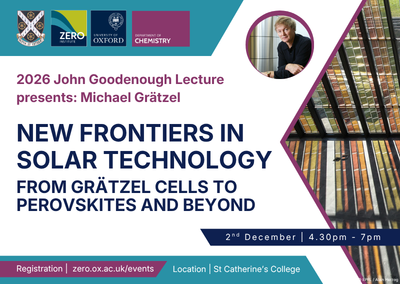
The ZERO Institute, in collaboration with St Catherine’s College and the Oxford Department of Chemistry, is delighted to host the 2nd annual John Goodenough Lecture, to celebrate discovery in science and engineering.
New Frontiers in Solar Technology | From Molecular Photovoltaics to Perovskites and Beyond
Guest Lecturer: Prof Michael Grätzel FRS, Professor of Physical Chemistry at École Polytechnique Fédérale de Lausanne.
Description: Harnessing the power of sunlight is central to the global transition away from fossil fuels. Some of the most innovative approaches to this challenge have looked to nature for inspiration, seeking alternative ways to harness light into energy.
Professor Michael Grätzel is the co-inventor of a pioneering third-generation photovoltaic technology inspired by the way plants harvest sunlight during photosynthesis. ‘Dye-Sensitised Solar Cells’, sometimes known as Grätzel cells, use tiny dye particles to imitate chlorophyll atop a porous layer of titanium dioxide nanoparticles. These solar cells have since been developed into low-cost, flexible, transparent and colourful photovoltaics capable of generating electricity even under low-light indoor conditions.
In this lecture, Michael will trace the evolution of this pioneering technology, from the development of Dye-Sensitised Solar Cells to the emergence of ‘Perovskite Solar Cells’, now regarded as one of the most promising next-generation photovoltaic technologies.
Michael will explore advances in materials design, physical and chemical processes, device architecture, and emerging strategies for achieving highly efficient, stable and scalable solar-energy conversion.
Venue: St Catherine’s College, Oxford OX1 3UJ (map)
Programme:
- 16.30 Arrival at St Catherine’s College
- 17.00 Welcomes from Pro-Vice-Chancellor for Research, Professor Patrick Grant, and Master of St Catherine’s College, Jude Kelly CBE, the Riverside Lecture Theatre
- 17.15 Lecture, Prof Michael Gratzel
- 18.30 – 19:15 Reception, the Riverside Foyers and Walkway
Abstract: Photoelectrochemical cells based on mesoscopic junctions comprising three-dimensional networks of semiconductor nanoparticles have attracted widespread scientific interest for the conversion of sunlight into electricity and chemical fuels. Their remarkable development was initiated by the advent of mesoscopic dye-sensitized solar cells (DSCs) more than three decades ago. DSCs offer a unique combination of practical advantages, including efficient electricity generation under a broad range of illumination conditions, ease of manufacturing, flexibility and transparency, bifacial light harvesting, and aesthetic versatility. These attributes have enabled their industrial-scale production and commercialization. Beyond their technological significance, DSCs provided an important conceptual and experimental foundation for the emergence of perovskite solar cells (PSCs), which have developed at an unprecedented pace into one of the most promising next-generation photovoltaic technologies. Power conversion efficiencies have now approached 28% for single-junction PSCs and 35% for perovskite-based tandem solar cells, highlighting the extraordinary potential of this rapidly evolving field. This lecture will trace the development of mesoscopic photoelectrochemical photovoltaics from dye-sensitized to perovskite solar cells and present our most recent findings in these closely interconnected fields. Particular emphasis will be placed on advances in materials design, interfacial and charge-transfer processes, device architecture, and emerging strategies for achieving highly efficient, stable, and scalable solar-energy conversion.
Biography: Michael graduated from the Technical University Berlin and was a postdoc at the University of Notre Dame (USA) before joining the EPFL faculty as a Professor of Physical Chemistry. He discovered mesoscopic dye sensitized solar cells, which in turn prompted the rise of perovskite solar cells, triggering a second revolution in photovoltaics. His publications had a major scientific impact and earned him wide recognition including the 2010 Millenium Technology Prize. He is a foreign member of the Royal Society (UK) and the Chinese Academy of Science as well as a member of the Swiss Academy of Technical Sciences, the German Academy of Science (Leopoldina),the Royal Spanish Academy of Engineering and a number of other learned societies. Michael received 17 honorary doctor degrees from European, Asian, American and African Universities.
All ZERO Institute’s events abide by our Code of Conduct.
The ZERO Institute (Zero-carbon Energy Research Oxford) brings together researchers from across the University of Oxford to tackle questions surrounding zero-carbon energy systems, and to accelerate multi-disciplinary research on the zero-carbon transition.