
Engineering Smart Electricity Grids Course
Engineering Smart Electricity Grids
Design, AI, Optimisation & Cybersecurity
This intensive two-day course led by experts at the University of Oxford, explores the engineering of modern smart electricity grids for the energy transition. Combining cutting-edge research with practical engineering tools, participants will develop the knowledge and skills to design, analyse and optimise future electricity networks, drawing on the latest advances in AI, distributed energy systems and cybersecurity.
Dates
18th & 19th March 2027
Networking dinner on 18th March
Price
£1,500 Standard Rate
£1,350 Early Bird Rate – Available until 30th November 2026
Group discounts are available: for enquiries please contact us at [email protected].
What’s Included
All teaching and course materials, a networking dinner at a prestigious venue in central Oxford and a course completion certificate.
Accommodation is not included.
Location
In-person at the ZERO Institute – University of Oxford, Holywell House, Osney, Oxford, OX2 0ES.
Dinner on 18th March will be at a University of Oxford college.
Course Description
The transition to net zero electricity systems is accelerating, but the grids that underpin them are struggling to keep pace. Across the Global North, the rapid growth of distributed renewable generation, electric vehicles and heat pumps is reshaping how energy systems operate, exposing the limits of ageing infrastructure and traditional grid design. Whilst in emerging economies, electrification access may be solved instead by establishing new solutions such as microgrids.
Participants will gain practical, actionable insights into grid design, network constraints, the integration of distributed generation and managing increasing electricity demand. The course also examines emerging solutions, including digitalisation, microgrids, optimisation techniques and cyber security in modern energy systems.
The course, designed for engineers and professionals working across the energy sector, combines expert-led teaching with practical exercises, including Python-based tools and AI-assisted approaches. Over two days, participants will gain practical knowledge and skills that can be applied immediately to the planning, analysis and operation of existing and future electricity grids.
Course Structure
Day 1 – Grid Design for the Global North and Emerging Economies
- Overview on power flow analysis and Python modelling
- Grid Design for Net Zero: National Grids and Microgrids
- Adapting National Power Grids using tools such as PandaPower and PyPSA
Day 2 – Smart Grids: Optimisation and Cybersecurity
- Cutting Edge Energy Forecasting using Deep Learning
- AI-Assisted Control of Distributed Energy Assets
- Security Implications of Smart Energy Devices
See below for the full course structure.
Course Leaders
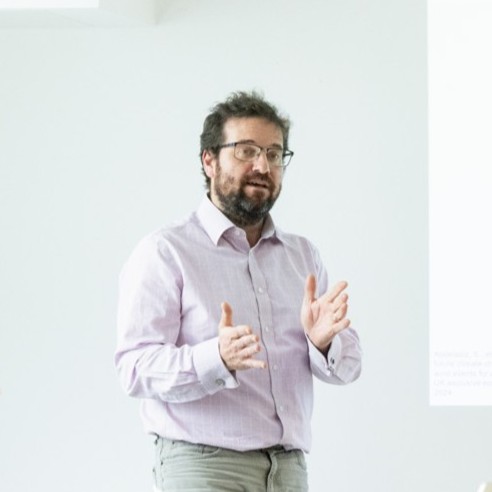
David Wallom is a Professor in Informatics at the University of Oxford, Course Director of the MSc in Energy Systems and Associate Director of Innovation at the Oxford e-Research Centre, where he leads two separate research groups, Energy and Environmental ICT, and Advanced e-infrastructure & Cloud Computing.
He has led over 55 research projects in areas such as Cloud utilisation, Cybersecurity, Smart Energy Grids, Research Data Management, Green IT, ICT Security and Institutional Repositories. He is a member of the GCHQ recognized Academic Centre of Excellence in Cyber Security and the UK Space Agency Ground segment Advisory Group.
Dr Scot Wheeler is a Senior Researcher and Departmental Lecturer in Energy Systems within the Department of Engineering Science at the University of Oxford. His research focuses on smart, flexible energy systems, investigating how digitalisation, data-driven methods and artificial intelligence can accelerate the transition to secure, low-carbon energy systems.
Alongside research, Scot teaches modules on Energy Infrastructure and Python for Energy System Analysis for the Energy Systems MSc course and is a Stipendiary Lecturer at Christ Church.

Who Should Attend?
This course is designed for engineers and technical professionals working in, or alongside, the energy sector who want to develop their understanding of future electricity grids.
It will be particularly relevant to:
- Electrical, power systems and energy engineers
- Grid planning, network and renewable energy professionals
- Engineers and technical specialists working for utilities, consultancies and energy technology companies
- Professionals working with smart grids, flexibility, energy storage or distributed energy resources
- Data, digital and cybersecurity professionals working in the energy sector
- Technical and project managers responsible for energy infrastructure and net zero projects
Learning Outcomes
Participants will gain practical knowledge and skills in:
- Smart grid design and optimisation
- Renewable energy and distributed generation integration
- Power flow modelling in Python
- AI and machine learning for energy forecasting
- Smart control of distributed energy resources
- Cybersecurity for critical energy infrastructure
The course also provides an opportunity to learn from University of Oxford experts and exchange perspectives with professionals working across the energy sector.
Full Course Structure
Day 1 – Grid Design for the Global North and Emerging Economies
Taught by Dr Scot Wheeler
Introduction – A refresh on non-linear power flow, the key physical theory behind power grid analysis and design.
This session will include common approaches to solving non-linear power flow in Python, including DC approximation and iterative methods such as Newton-Raphson, and an example on setting up a basic 3 bus power flow in python.
Grid Design for Net Zero: National Grids and Microgrids – Infrastructure challenges for net zero grid design and emerging grid topologies for energy access in greenfield developments.
The session will include:
- What physical network constraints exist on the power grid and why.
- How net-zero technologies are changing the way electricity grids operate and how this exacerbates network constraints.
- How to make techno-economic design decisions to overcome network constraints within a basic python power flow.
- Different options for rural electrification, for example solar home systems, DC vs AC microgrids and grid expansion.
- Group work to design an AC distribution grid for energy access in a Sub-Saharan Africa context with knowledge sharing between groups and case studies.
Adapting Established National Power Grids to Overcome Net Zero Challenges – This session will use open-source tools within python that make power flow analysis and power grid design accessible (such as PandaPower and PyPSA) to model the case studies introduced in the course so far and consider design options for future net zero grids.
The session will include:
- Innovation overcoming constraints at the transmission and distribution level.
- How net zero technologies are changing the UK power grid.
- Creating a power flow model in Python using the PyPSA library and using this model to analyse the microgrid and established grid case studies.
- Group work using the model to perform an optionality assessment to overcome grid constraints of either:
-
-
- infrastructure upgrades or
- smart grid flexibility options.
-
-
Day 2 – Smart Grids: Optimisation and Cybersecurity
Taught by Prof David Wallom
Cutting Edge Energy Forecasting using Deep Learning – This session will explore how the jump in computational capacity driven by the demand for AI is enabling powerful deep learning approaches to energy forecasting.
The session will include:
- The importance of forecasting of demand and generation in a net zero energy system.
- How state-of-the-art machine learning and deep learning algorithms are transforming energy system forecasting.
- How to deploy deep-learning time series models for energy forecasting in python.
AI-Assisted Control of Distributed Energy Assets – As the market becomes flooded with smart energy technologies, how do we provide the control signals that ensure efficiency of a net-zero energy system while maintaining system security and stability?
The session will explore:
- The benefits and risks associated with automation and control across
- Methods for smart control of distributed energy assets including centralised, decentralised, or tariffs based
- Use of AI assisted decision-making tools for distributed energy assets
Security Implications of Smart Energy Devices – The energy system is part of critical national infrastructure. How should we be securing communication channels and equipment and keeping data private in the future smart net zero energy system?
The session will explore:
- The vulnerabilities introduced by ‘smart’ devices
- The current regulatory environment that covers smart energy devices and data
- Novel methods for securing communication, equipment and data as part of critical national infrastructure without supressing innovation.
- Group work on improving cyber security.
More from ZERO Institute

About the ZERO Institute
We want to shape the transition to a just and fair global zero-carbon energy system, through research that unifies technology, policy, and people.

Our People
The ZERO Institute is a multi-disciplinary hub for zero-carbon energy research, bringing together academics from across the University of Oxford.

Latest News
Catch up on the latest news and events to see how ZERO is driving the transition to a zero-carbon energy system.