The ZERO Institute is inviting applications for our newly launched DPhil course in Zero Carbon Energy Research at Oxford University.
The innovative DPhil (PhD) programme will equip students with the skills needed to lead in the energy transition. The DPhil will combine individual research projects with an interdisciplinary and multidisciplinary training programme led by the ZERO Institute.
We welcome research projects targeting areas with the potential for system-level impact on scientific, engineering or societal aspects of zero-carbon energy, with possible themes including energy systems modelling, energy policy and governance, and the production and storage of renewable energy.
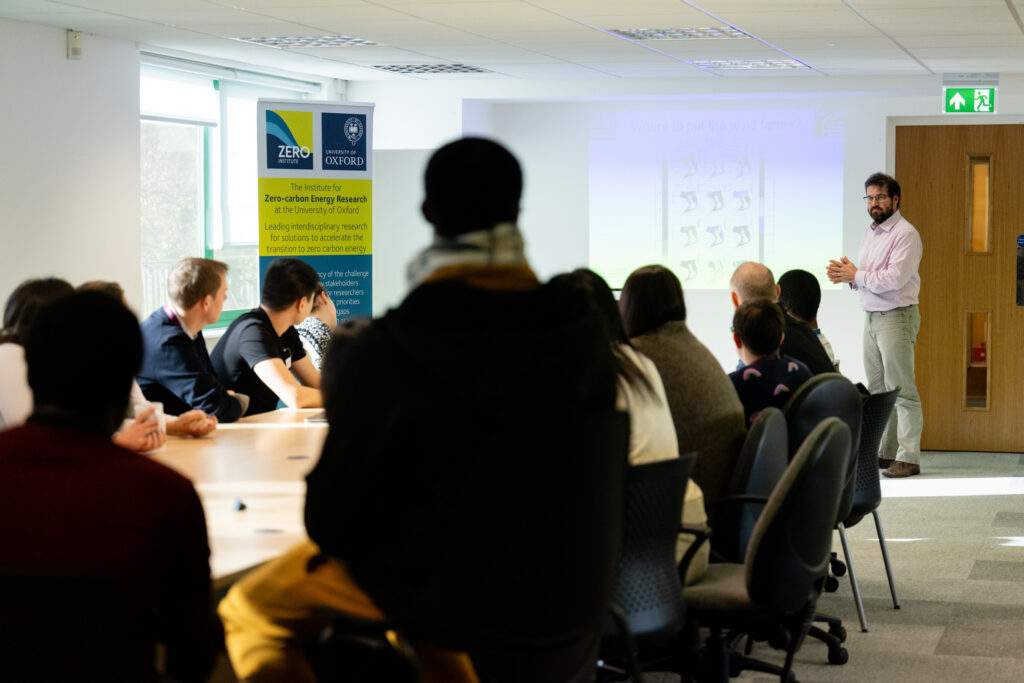
The novel training programme will incorporate a diversity of learning and networking opportunities, such as seminars or talks on core aspects of the energy transition, multidisciplinary summer schools or retreats, networking sessions, enterprise training and internship opportunities, elevating the student experience beyond pure research and opening doors into a real-world, collaborative community. Students will access world-class researchers and academics, and department facilities spanning the Mathematical, Physical and Life Sciences and Social Sciences (MPLS) Division, as well as a supportive group environment within which to study and learn. We aim to foster a multidisciplinary cohort of zero-carbon energy DPhil students, across departments and disciplines.
“Our exciting new DPhil programme aims to bridge the gap between disciplines, equipping students with the knowledge and connections for impactful careers in the Zero Carbon Energy space.” ZERO Institute Director, Paul Shearing
We expect that the majority of applicants who are offered a place on this course will also be offered a fully-funded scholarship specific to this course, covering course fees for the duration of their course and a living stipend.
For more information and to apply, visit the course page on the University of Oxford’s website. Applications are open, with a maximum of 6 places available.
Please direct all enquiries about this course to ZERO-DPhil@eng.ox.ac.uk.