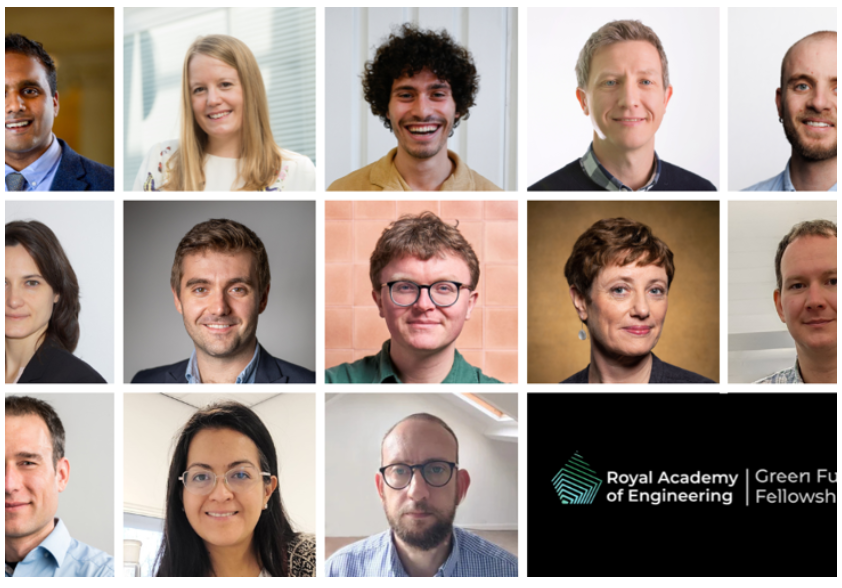
The Royal Academy of Engineering has awarded £39M to the first ever Green Future Fellows, funded by a £150M long-term investment from the Department for Science, Innovation and Technology. The research work to be carried out will be located in the UK, although the solutions the Fellows develop will be of global significance. Numbering 13 Fellows in total, this first cohort will each receive £3M to develop solutions to tackle a variety of causes of the climate crisis, and to mitigate and adapt to its impacts. At least 50 Green Future Fellows will be appointed over five years. Successful applicants become a Green Future Fellow for the 10-year award duration, receiving up to £3M alongside non-financial support, such as training, mentorship, access to the Academy’s network of exceptional innovators, and additional tailored support.
We are delighted that among the 13 fellows in this first cohort are Professor Robert House and Professor Moritz Riede, from the University of Oxford’s Materials and Physics Departments respectively.
 Professor Robert House
Nanoengineering battery electrodes for green electric flight
A new type of rechargeable battery that’s four-times more energy dense than current state-of-the-art lithium-ion (Li-ion) batteries, making them much lighter and more powerful, perfect for electric or hybrid planes. Using nanoengineering, they overcome the challenges of current Li-ion batteries, which carry a lot of excess unused weight in the electrode materials, instead storing energy using lighter structures. Increasing the energy density four-fold means batteries can be made much smaller and lighter, which could help to electrify aeroplanes.
 Professor Moritz Riede
Achieving Terawatt-Scale Organic Photovoltaics
Organic photovoltaics (OPV) are solar cells made from carbon-based materials. These panels are flexible, lightweight and can be used on almost any surface. They already work well in the laboratory, but they are not yet good enough for factories to make cheaply at scale. OPV will complement traditional solar panels where they do not work, for example on curved surfaces, transparent building facades, or wearable electronics, and provide clean energy at a fraction of the environmental footprint of traditional solar panels. Professor Riede will use AI and robots to test thousands of designs automatically and quickly to improve OPV so they match what the best labs can do – accelerating OPV commercialisation, supporting UK Net Zero goals and advancing a fair clean energy transition everywhere.
You can read the full press release from the Royal Academy of Engineering here: Pioneering engineers awarded landmark funding for climate innovations